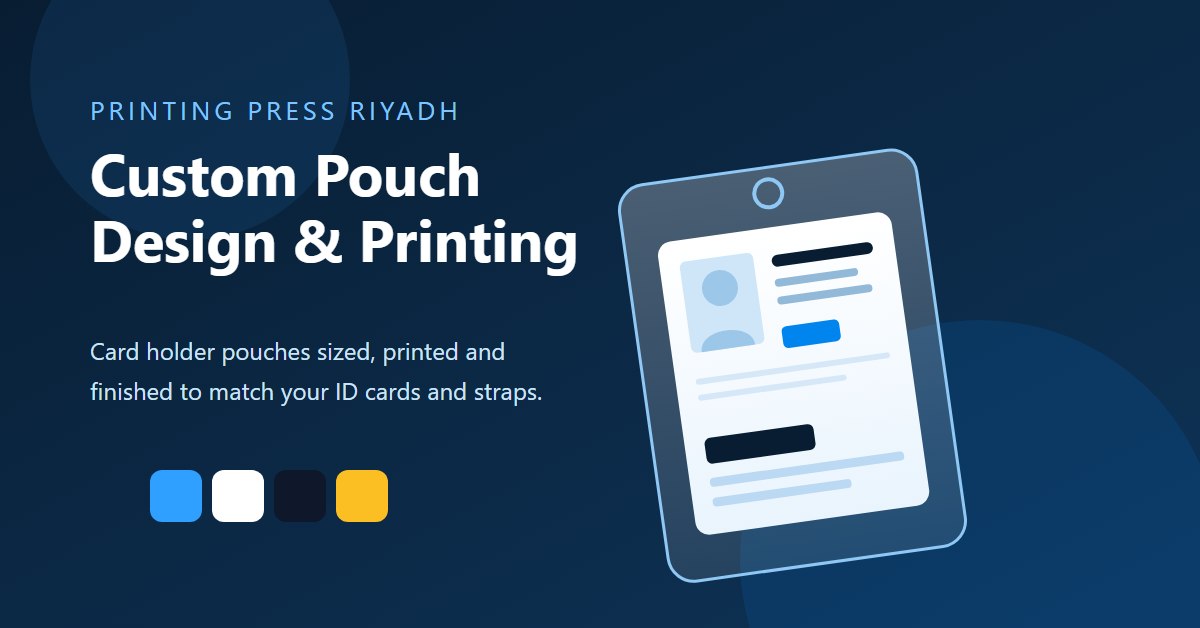
A card holder pouch is the part of an ID programme people touch all day, so its custom pouch design and printing deserves the same attention as the card itself. Size, window position, material, colour and attachment point decide whether a badge stays readable, whether cards slide in easily, and whether the pouch still looks presentable after months of daily use. This guide covers the decisions behind pouch printing in Riyadh, from artwork to bulk delivery.
Pouches are usually ordered with lanyards and printed ID cards, and the three parts only work well when they are specified together. A pouch that is 2 mm too narrow bows the card; a window that is too small hides the photo; a dark backing that clashes with a light card makes the whole badge look muddy. None of that is expensive to fix at the design stage.
Pouch design at a glance
| Decision | Options | What it affects |
|---|---|---|
| Orientation | Vertical or horizontal | How the card is read and how the badge sits on the chest |
| Window | Full clear front, partial window, no window | Visibility of photo, name and access colour |
| Material | PVC, PU, rigid plastic, recycled board | Durability, feel and print method |
| Printing | Sublimation, silk screen, DTF, UV | Colour range, detail and cost per unit |
| Attachment | Slot, clip, reel, lanyard loop | How the pouch hangs and how quickly it can be swapped |
| Colour | Brand colour, neutral, transparent | Contrast with the card and the uniform |
What a pouch actually consists of
A standard ID pouch is a folded or welded sleeve with a clear front panel and a printed or coloured back panel. The card enters through the top, sits against the window, and is held by the fit of the sleeve rather than by adhesive. Small variations in the fold, the weld line and the window cut change how the card sits, which is why sample approval matters on a large order.
- Front panel: clear material, usually with a punched slot or reinforced eyelet for the clip.
- Back panel: the printable surface that carries the brand, department colour or event identity.
- Window: the clear area that exposes the card's photo, name and access markings.
- Attachment point: slot, eyelet or loop that connects the pouch to the lanyard or reel.
- Edge finish: welded, stitched or folded, which affects stiffness and lifespan.
Sizes and orientations
Most pouches are built around the CR80 card format, roughly 85.6 × 54 mm, the same footprint as a bank card. The pouch is slightly larger to allow the card to slide in without binding, with a few millimetres of clearance on each side. Vertical orientation is the default for staff badges because the card hangs in portrait and the photo sits near eye level; horizontal pouches suit visitor passes, event credentials and cards with wide layouts.
| Format | Card fit | Common use |
|---|---|---|
| Vertical ID pouch | CR80 portrait | Staff badges, schools, hospitals |
| Horizontal pouch | CR80 landscape | Visitors, conferences, events |
| Oversized pouch | CR80 plus a proximity card | Access control with a separate fob |
| Zip or seal pouch | CR80 with a closure | Sites where cards must not fall out |
| Badge holder with reel | CR80 plus retractable cord | Tills, help desks, security desks |
If the card carries a chip or a thick laminate, check the internal clearance before approving the pouch. A card that fits a standard sleeve can sit tight once it is laminated or fitted with an RFID inlay.
Pouch materials
- PVC: the most common choice. Clear front, printable back, soft enough to flex without cracking, and economical at volume.
- PU or synthetic leather: a more premium feel for hotels, corporate offices and executive programmes.
- Rigid plastic: holds its shape well and protects the card on site, but is bulkier on a lanyard.
- Recycled or board-based: suitable for events and short-life credentials where sustainability messaging matters.
- Anti-print-transfer film: reduces ink transfer between the card and the window in hot, humid conditions.
Material choice should follow the environment. A hospital pouch is cleaned and handled constantly; a conference pouch needs to look good for three days. Specifying the same pouch for both usually means paying for durability nobody needs in one case, or replacing pouches early in the other.
Printing the pouch back panel
| Method | Best for | Limits |
|---|---|---|
| Dye sublimation | Full-colour artwork, gradients, photos | Needs a compatible coated surface |
| Silk screen | One to three spot colours, high volume | Setup cost per colour; less detail |
| DTF transfer | Short runs with fine detail | Durability varies with handling |
| UV print | Crisp logos on rigid panels | Thicker ink layer; not for every flexible film |
Because the back panel is small, the design has to be simplified. A full logo lock-up with a tagline and an address rarely survives at pouch scale. Reduce to the mark, one line of text and the brand colour, then let the card carry the detail.
Windows, visibility and access
The window is a functional element, not just a cut-out. It has to expose the card's photo, name and any colour-coded access band while hiding the personal data the organisation does not want on display. On vertical badges, a window that starts a few millimetres below the slot keeps the card from riding up; on horizontal passes, a full-width window shows the layout as designed.
- Check that the window clears the card's photo and name area with a consistent margin.
- Decide whether the card's barcode or QR code needs to be scannable through the window.
- Avoid printing dark artwork directly behind a small window — it reduces contrast for the card text.
- If the pouch will carry a proximity card, confirm the reader can scan through the material.
Artwork setup for pouch printing
| Item | What to supply |
|---|---|
| Template | Use the pouch dieline supplied for the chosen format and orientation |
| File format | Vector PDF or AI with outlined text; 300 dpi raster only if unavoidable |
| Colour | CMYK plus Pantone for brand colours; confirm how the clear film affects appearance |
| Safe area | Keep type and logos clear of weld lines, punch holes and window edges |
| Scale | Set the logo to be legible at final size, not at screen zoom |
| Proof | Digital proof for layout; physical sample for colour and material approval |
Attachments and compatibility
The pouch has to connect to the rest of the badge system, so the attachment should be chosen with the lanyard fitting in mind. A punched slot suits a metal hook; an eyelet suits a clip or reel; a fabric loop suits a strap that threads through. Ordering pouches, lanyards and cards as one set removes the guesswork, and it is how most of our Riyadh clients buy: see the lanyard and ID accessory service for the combined option.
Pouch design mistakes to avoid
- Designing to a card size without allowing for lamination or a chip inlay.
- Placing the logo where the clip or punch hole will cut through it.
- Using a transparent pouch with a dark card, which makes the whole badge look dull.
- Choosing a window that hides the access colour or the photo.
- Printing fine text that closes up on a textured or flexible surface.
- Approving colour on screen without checking the clear film's effect on the backing print.
What drives pouch cost
| Factor | Effect on price |
|---|---|
| Quantity | Unit cost drops with volume; setup is shared across the run |
| Material | PVC is the baseline; PU, rigid and specialty films cost more |
| Print method | Spot-colour silk screen has per-colour setup; sublimation suits full colour |
| Window and format | Custom dielines and non-standard windows need separate tooling |
| Attachments | Eyelets, reels and clips add per-unit hardware cost |
| Packing | Individual bagging or kitting with cards and lanyards adds handling time |
Pouch printing in Riyadh and delivery
Printing, cutting and finishing run in our Riyadh facility alongside lanyard and card production, so the set is checked together before dispatch. Standard orders are delivered in Riyadh within a working day once approved, with scheduled transport to Jeddah, Dammam, Khobar, Makkah, Madinah and the rest of Saudi Arabia. For larger rollouts, we can pack pouches by site or department so distribution on the day is straightforward.
How to order custom pouches
- Send the card size, orientation, quantity and intended use.
- Choose the material, window style and attachment.
- Approve the artwork on the correct pouch dieline.
- Confirm the written quotation and production date.
- Receive the pouches, or the complete lanyard, card and pouch set.
A small product with a big effect on presentation
Pouches are inexpensive relative to the rest of an ID programme, but they are the part people see at close range every day. Getting the size, window and colour right makes the card look better, keeps the lanyard sitting correctly and gives the whole badge a finished, intentional appearance.
If you are sourcing the complete badge set, read our lanyard manufacturing guide for Saudi Arabia alongside this one.
Custom pouch printing FAQ
It is a small sleeve, usually with a clear front and a printed or coloured back, that holds an ID card and attaches to a lanyard, clip or reel. The card slides in from the top and sits against the window, so the photo and name stay visible without removing it.
Standard pouches are built for the CR80 card at roughly 85.6 by 54 mm, the same footprint as a bank card. If the card will be laminated, fitted with a chip or made thicker than usual, send the final card thickness so the internal clearance can be checked before production.
Yes. The back panel can be printed in full colour by sublimation or DTF, including gradients and photographs, or in one to three spot colours by silk screen for high-volume runs. The clear front stays unprinted so the card remains readable.
Choose a thicker PVC, a sealed or zip top, and a darker backing that hides scuffs. Rigid plastic holds its shape better on site, while a standard soft pouch is fine for offices, schools and short events where the badge is handled less roughly.
Yes. We produce the pouch, the printed ID card and the lanyard in the same Riyadh facility, which means the window, slot, card size and strap fitting are checked together and the set arrives colour-matched and ready to distribute.
Bottom line
Size, window and colour decide whether a pouch looks professional on day one and still does months later. Order pouches with lanyards and ID accessories from our Riyadh factory, and ask for a physical sample when the material or brand colour matters.